
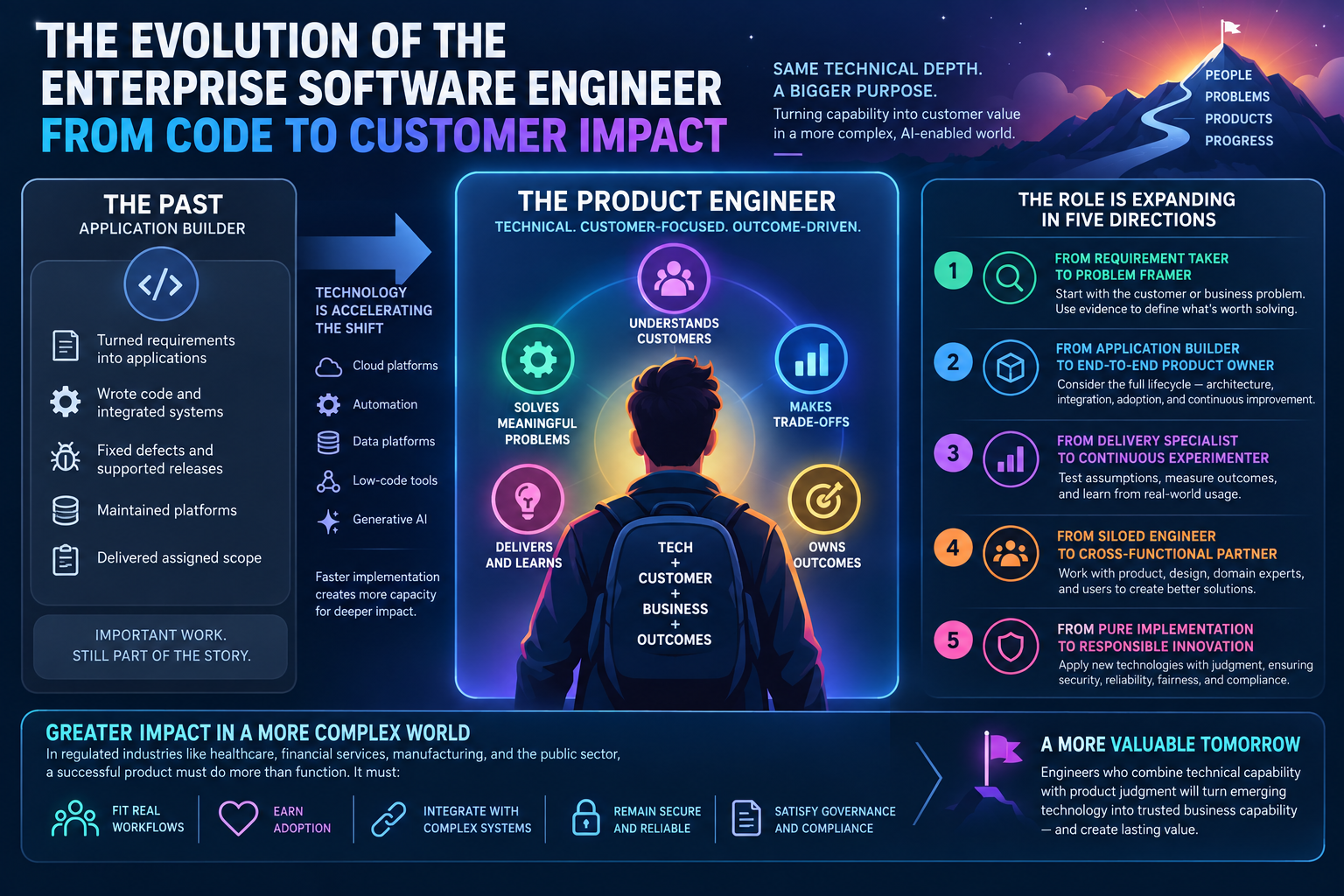
Software engineering is entering a structural shift.
For decades, enterprise engineers were primarily valued for turning requirements into applications: writing code, integrating systems, fixing defects, supporting releases, and maintaining platforms. Those responsibilities still matter. But cloud, automation, data platforms, and generative AI are reducing the cost of implementation and changing where engineers create the most value.
The enterprise software engineer is becoming a product engineer: someone who combines strong technical capability with customer understanding, business context, and responsibility for outcomes. Rather than starting with a specification and ending with a release, product engineers help define the problem, explore solutions, make trade-offs, deliver the product, and learn from how it performs in the real world.
This shift matters most in large, regulated organizations. In healthcare, financial services, manufacturing, and the public sector, a useful product must do more than function. It must fit real workflows, earn adoption, integrate with complex systems, remain secure and reliable, and satisfy governance and compliance expectations.
The future engineer will remain deeply technical. But their differentiator will increasingly be product judgment: knowing which problems are worth solving, what evidence should guide a decision, what to automate, where human approval is essential, and how to turn emerging technology into trusted business capability.
Technology is accelerating the shift
Product engineering is not emerging because coding no longer matters. It is emerging because implementation is only one part of creating a successful product.
Cloud platforms, reusable services, automation, low-code tools, data platforms, and generative AI all make it faster to turn an idea into working software. Generative AI can already produce boilerplate, explain unfamiliar code, create tests, assist with refactoring, summarize pull requests, and help debug issues. These capabilities give engineers more capacity to understand users, evaluate options, improve the experience, and measure whether the product is creating value.
Expertise remains essential. Generated code can be incomplete, insecure, inefficient, subtly incorrect, or difficult to maintain. Engineers must still understand the system, challenge outputs, recognize hidden failure modes, and take responsibility for what reaches production.
AI is therefore a catalyst for product engineering, not its definition. The broader change is from implementing assigned scope to owning problems and outcomes—from the first customer insight through architecture, delivery, operation, adoption, and continuous improvement.
The role is expanding in five directions
1. From requirement taker to problem framer
Product engineers do not begin with a ticket. They begin with the customer or business problem.
They work with product managers, designers, domain experts, and users to understand the workflow, identify friction, challenge assumptions, and define the outcome that matters. Before committing to a solution, they ask:
- Who has this problem, and how significant is it?
- What evidence shows that it is worth solving?
- What behavior or business result should change?
- What is the simplest way to test the hypothesis?
- Should the solution automate, assist, inform, or request approval?
- How will we measure adoption, quality, cost, risk, and value?
Technical insight becomes part of product discovery rather than something introduced only after requirements have been finalized.
2. From application builder to end-to-end product owner
Useful enterprise products rarely stand alone. They depend on identity, data, APIs, business processes, operational systems, support models, and compliance controls.
Product engineers consider this full lifecycle from the beginning. They make architecture and integration decisions with the user experience, operating model, cost, scalability, and maintainability in mind. They remain accountable after launch—observing usage, resolving friction, improving reliability, and deciding what to enhance, simplify, or retire.
The goal is not merely to ship an application. It is to sustain a product that people trust and continue to use.
3. From delivery specialist to continuous experimenter
Traditional delivery often treats requirements as facts and release as the finish line. Product engineering treats assumptions as things to test.
Engineers help prototype ideas, instrument products, analyze usage, run controlled experiments, and combine quantitative data with customer feedback. A feature that ships on time but fails to improve the intended outcome is not automatically a success.
AI adds new evaluation needs—such as groundedness, safety, bias, model quality, and human review—but the principle applies to every product: build feedback loops that reveal whether the solution is useful, usable, reliable, and valuable.
4. From siloed engineer to cross-functional partner
Product engineers work as part of a persistent team rather than a downstream implementation function.
They collaborate continuously with product management, design, data, security, operations, legal, compliance, and business stakeholders. This does not erase specialist roles. It creates shared responsibility for discovering the right problem, choosing a viable solution, and delivering the intended outcome.
Strong product engineers communicate trade-offs clearly, bring technical possibilities into early conversations, and use customer and business context to improve engineering decisions.
5. From technical implementer to trusted enterprise product builder
In complex enterprises, speed and customer value must coexist with security, reliability, privacy, compliance, and operational resilience.
Product engineers translate these requirements into working product capabilities:
- Role-based access and least privilege
- Data protection, masking, and classification
- Secure interfaces and integration patterns
- Audit logging and records retention
- Human approval for high-impact decisions
- Observability, support, and incident response
- Explainability and traceability where required
- Model, vendor, and AI-specific controls when applicable
Governance cannot be bolted on at the end. In a product-engineering model, trust is part of the user experience and part of the product definition.
A six-part capability model
The future-ready enterprise engineer needs a broader profile across six dimensions:
| Capability | What it means |
|---|---|
| Core engineering | Programming, architecture, APIs, databases, testing, debugging, performance, and maintainability |
| Cloud and operations | CI/CD, containers, infrastructure automation, observability, reliability, deployment, and incident response |
| AI and data fluency | Generative AI patterns, retrieval, agents, model evaluation, data pipelines, and model limitations |
| Security and governance | Secure development, privacy, access control, auditability, responsible AI, and risk-based design |
| Product and business orientation | User workflows, prioritization, value hypotheses, adoption, cost, and outcome measurement |
| Collaboration and communication | Working across business, product, data, security, legal, compliance, and operations |
The strongest engineers will not necessarily know every model or framework. Tools will change too quickly for that to be a durable advantage. The differentiator will be the ability to combine strong fundamentals with AI fluency, business context, and risk awareness.
What enterprises should change
Organizations cannot create product engineers simply by changing job titles or issuing new tools. The operating model must give engineers the context, authority, capabilities, and feedback needed to own outcomes.
Enterprises should redesign software delivery around five principles:
- Organize around products, not temporary projects. Build long-lived teams around customer journeys, business capabilities, or platforms. Persistent ownership allows teams to develop domain knowledge, learn from production, and improve outcomes over time.
- Unite discovery and delivery. Bring engineers into customer research, problem framing, solution exploration, and experimentation—not only estimation and implementation. Product managers, designers, and engineers should jointly determine what is valuable, usable, feasible, and viable.
- Empower teams within clear guardrails. Give teams authority to solve defined problems while establishing enterprise standards for architecture, security, privacy, compliance, reliability, and responsible AI. Governance should enable safe speed rather than operate only as a late-stage approval queue.
- Measure outcomes rather than activity. Track adoption, task success, customer satisfaction, cycle time, reliability, operating cost, business value, and risk. Lines of code, story points, release counts, and numbers of pilots are not measures of product success.
- Invest in shared platforms and product-engineering careers. Provide reusable identity, data access, observability, deployment, experimentation, AI, and governance capabilities. Update role expectations, training, and career frameworks to reward customer understanding, collaboration, technical excellence, and product impact.
AI-assisted coding can increase local productivity, but faster implementation does not automatically create enterprise value. Without empowered product teams and an end-to-end operating model, the bottleneck simply moves to discovery, review, integration, adoption, or governance.
What individual engineers should do
For software engineers, the message is not that AI will replace the profession. The more accurate message is that AI will raise expectations.
First, preserve the fundamentals. Architecture, testing, security, debugging, performance, and maintainability become more important when machines can generate plausible code at high speed.
Second, build practical AI fluency. Learn how language models behave, how retrieval-augmented generation works, how agents use tools, how to evaluate outputs, and how cost, latency, and model choice affect the product.
Third, develop enterprise judgment. Understand privacy, compliance, cybersecurity, vendor constraints, change management, and operational support. A prototype demonstrates possibility; an enterprise system earns trust.
Finally, become outcome-oriented. Connect technical work to reduced cycle time, improved reliability, better decisions, lower operating cost, stronger compliance, or a better customer and employee experience.
The engineer becomes more central
Automation and generative AI will reduce the effort required for parts of software implementation. They will also increase the value of engineers who can understand customers, frame the right problems, make sound technical decisions, navigate enterprise complexity, and remain accountable for outcomes.
The enterprise software engineer is not becoming less important. The role is becoming broader and more consequential.
The future belongs to product engineers who combine technical depth with customer empathy, business judgment, and end-to-end ownership—not merely building software that works, but creating trusted products that solve meaningful problems and continue to deliver value.
Further reading
- The Product-Minded Software Engineer — The Pragmatic Engineer — Nine traits engineers can develop to connect technical decisions with customer and business outcomes.
- AI Turns Software Engineers into Product Engineers — Atlassian — How AI shifts engineering from ticket implementation toward problem definition, validation, and product ownership.
- What Is a Product Engineer? — PostHog — A practical definition of product engineering centered on users, impact, iteration, and end-to-end ownership.
- Products Over Projects — Martin Fowler — Why long-lived, cross-functional teams should own business outcomes rather than deliver temporary project scope.
- The Product Operating Model: An Introduction — Silicon Valley Product Group — How empowered product teams combine engineering, design, and product management to solve customer problems.